
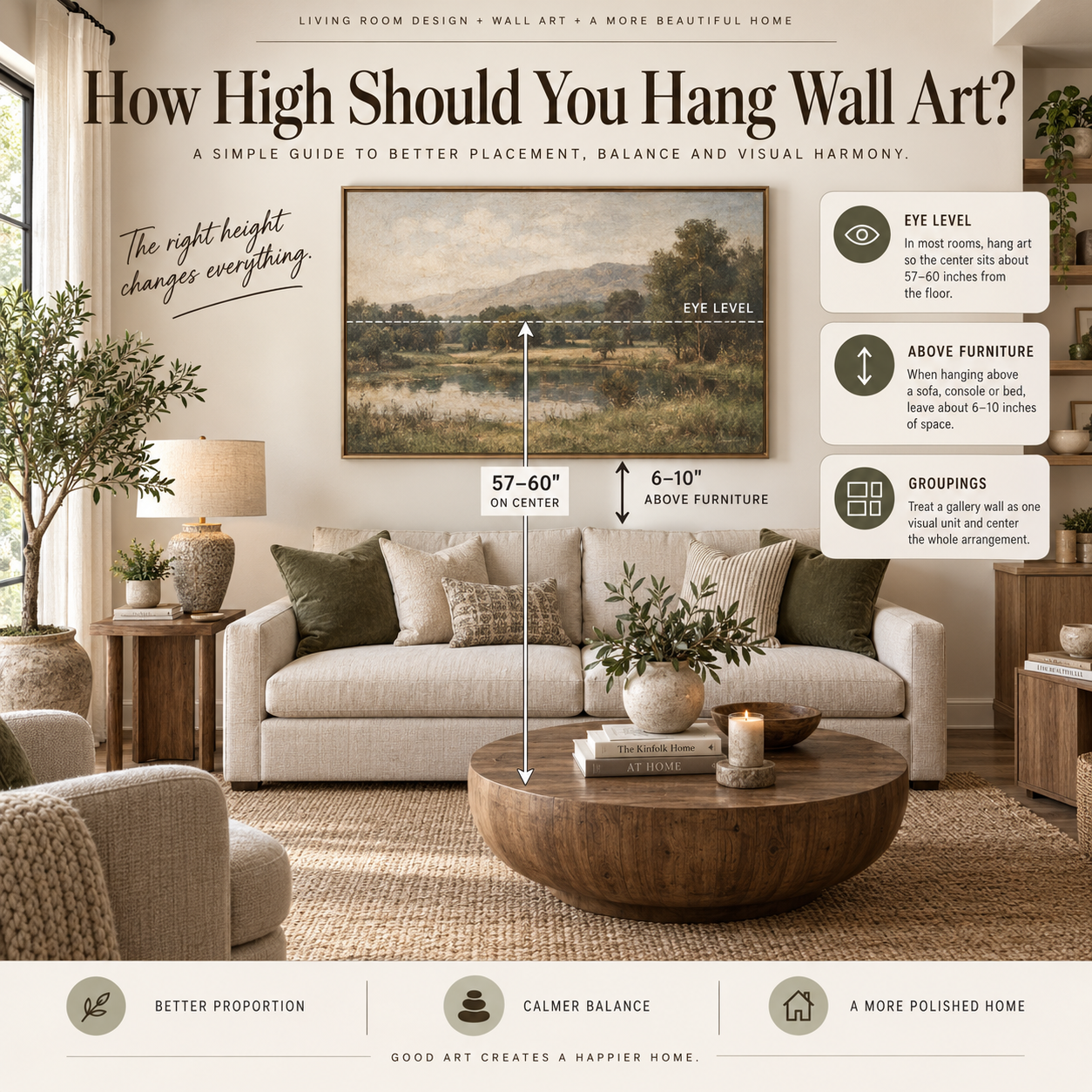
How High Should You Hang Wall Art?
For artwork hanging on an open wall, a commonly useful guideline is to place the center of the artwork around average eye level, often approximately 57 to 60 inches from the floor.
But that rule changes when furniture sits below the art.
Why Height Matters
Artwork can be the correct size and still feel wrong because it is hanging too high.
When art is placed far above a sofa or console, the furniture and artwork no longer feel connected.
Instead, the painting seems to float somewhere near the ceiling.
On an Empty Wall
For artwork without furniture below it, start by positioning the center roughly 57–60 inches from the floor.
For very large artwork, focus on the visual center rather than the top or bottom edge.
Above a Sofa
A useful starting distance is about 6–10 inches between the top of the sofa and the bottom of the artwork.
This creates a relationship between the two objects.
Above a Bed
Measure from the top of the headboard.
Again, 6–10 inches is often a useful range, although tall headboards or unusually low ceilings may require adjustment.
Above a Console Table
Artwork should usually feel connected to the console rather than to the ceiling.
Approximately 6–12 inches above the furniture can work depending on the decorative objects placed on the console.
What About Tall Ceilings?
One of the most common mistakes in rooms with high ceilings is hanging artwork much higher simply because more wall is available.
Resist the temptation.
Artwork is primarily experienced by people—not ceilings.
Keep it visually connected to human eye level and nearby furniture.
Gallery Walls
Treat the complete gallery arrangement like one large artwork.
Find the visual center of the entire grouping and place that center near an appropriate viewing height.
Do not position each individual piece independently.
Large Statement Art
Oversized artwork naturally occupies more vertical space.
You may need to move the center slightly depending on furniture relationships, but avoid placing the bottom edge so low that it becomes vulnerable to damage.
Use Your Eyes, Not Just the Tape Measure
Measurements create a good starting point.
Then step across the room and look again.
Does the artwork feel connected to the furniture?
Does it feel comfortable to view?
Does it create an intentional composition?
Those questions matter more than following a number perfectly.
Preview Before Drilling
If possible, test the placement before making permanent holes.
Painter's tape can outline the dimensions on the wall.
Digital visualization can go even further by showing the artwork itself in the room.
Use CANVONA's room visualization tools to compare sizes and placement before installation.