
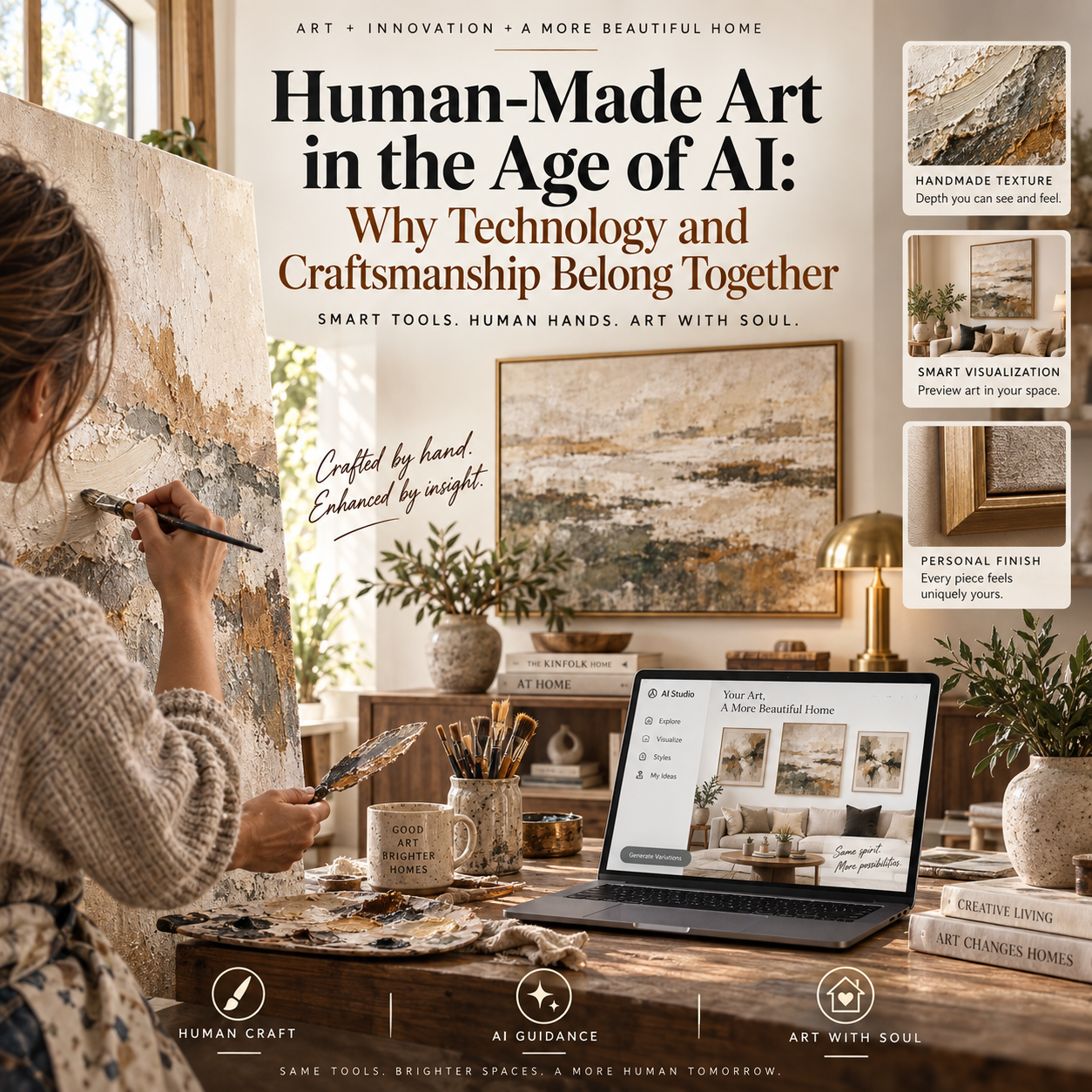
Human-Made Art in the Age of AI: Why Technology and Craftsmanship Belong Together
AI can create an image in seconds.
So what should happen to handmade art?
We believe the answer is not “AI or humans.”
It is understanding what each does well.
AI Is Excellent at Exploration
Imagine trying to explain a visual idea:
“I want something calmer than this, warmer than that, with less detail, but still inspired by our wedding photograph.”
Traditionally, translating that sentence into a visual concept could require significant back-and-forth.
AI can make exploration faster.
It can help people compare styles, discover compositions and communicate an idea visually.
That is useful.
But an Image Is Not an Object
A screen can show texture.
It cannot become texture.
Physical artwork exists in three dimensions.
Paint catches light.
Metal has weight.
Brushstrokes create relief.
Cut openings reveal the wall behind them.
Edges matter.
Frames matter.
Materials age.
Those are properties of objects, not JPEGs.
The Future Isn't Less Human
Paradoxically, as digital imagery becomes easier to create, real craftsmanship may become more meaningful.
When almost anyone can generate a polished image, physical evidence of human work becomes more noticeable:
a brushstroke,
a slight variation,
a textured surface,
a carefully finished metal edge.
Imperfection can become a signal of authenticity.
Transparency Matters
There is another reason this distinction is important.
Customers deserve to know what they are purchasing.
A digitally printed image should be described as a print.
A hand-painted artwork should accurately describe the painting process.
If AI contributes to a customized design concept, that involvement should not be hidden behind vague claims of traditional artistry.
Long-term brands are built through trust.
AI Can Improve the Shopping Experience
We see enormous potential for AI before the artwork is made.
For example:
helping customers understand what style works in their room,
identifying appropriate dimensions,
narrowing thousands of artworks into a useful selection,
previewing pieces in a real room,
and helping transform personal photographs into creative concepts.
These are areas where technology can reduce friction.
Humans Can Focus on What Humans Do Best
Artists and craftspeople can then concentrate on:
composition,
color,
texture,
physical materials,
finishing,
and the thousands of small decisions that determine whether the final object feels right.
This is not technology replacing art.
It is technology changing the way people find and participate in art.
Our Philosophy
Our approach can be summarized simply:
AI-assisted discovery.
AI-assisted personalization.
Human craftsmanship.
Disciplined production.
Human customer service.
The digital and physical worlds do not need to compete.
The strongest art ecommerce experience may come from connecting them.
The Question Has Changed
For decades, online art shopping asked:
“What artwork do you want?”
A better question is emerging:
“What artwork belongs in your space and means something to you?”
Technology can help answer the first part.
Only people can truly answer the second.
Discover artwork created with human craftsmanship and a smarter way to find what belongs in your home.