
The Complete Wall Art Size Guide: How Big Should Your Art Be?
Buying beautiful artwork in the wrong size is one of the easiest ways to make a room feel unfinished.
A piece can be beautiful on its own and still look completely wrong when it is too small for the furniture or wall surrounding it.
Here is a practical way to choose better proportions.
Wall Art Above a Sofa
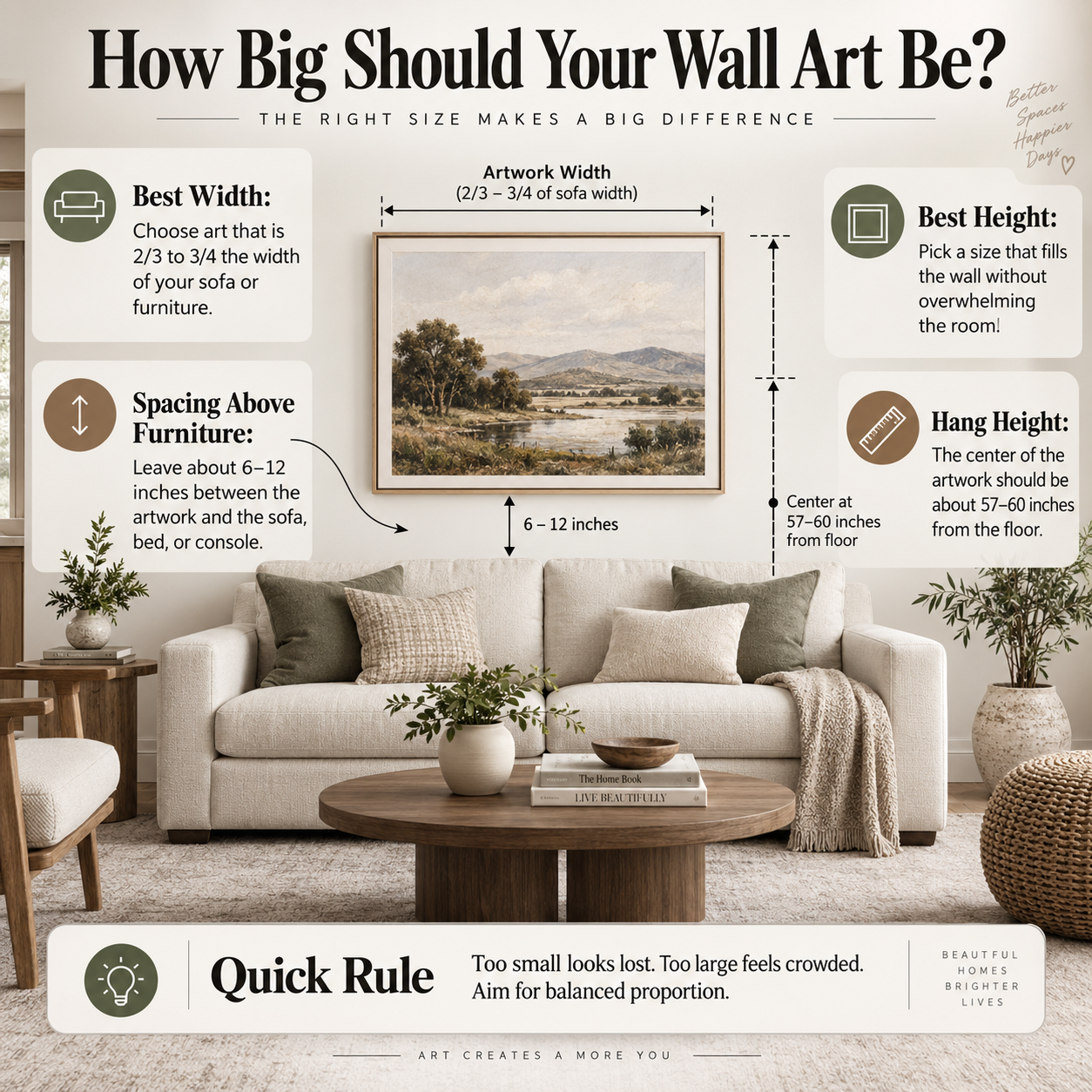
Start with the width of your sofa.
As a general design starting point, artwork spanning approximately 60% to 75% of the sofa width usually creates a balanced relationship.
For example, above a 90-inch sofa, you might begin evaluating artwork or an art grouping approximately 54 to 68 inches wide.
That does not mean every room requires those exact dimensions. Architecture, furniture and visual weight matter too.
The purpose of the rule is simply to prevent the artwork from looking lost.
How High Should Art Hang Above a Sofa?
Avoid creating a large empty gap between the furniture and artwork.
Approximately six to ten inches between the top of the sofa and bottom of the art often feels visually connected.
If the artwork is placed too high, the sofa and art can appear like unrelated objects.
Artwork Above a Bed
The same proportional idea applies.
Start with the width of the headboard rather than the entire wall.
King beds can usually support larger statement pieces, diptychs or triptychs.
Queen beds may work well with one medium-to-large piece or a coordinated pair.
Always consider the height of the headboard before deciding where the artwork begins.
Dining Rooms
Dining rooms give you more flexibility because there may be no sofa or bed creating a fixed visual anchor.
Large horizontal artwork works well on long dining-room walls.
A tall vertical piece can work particularly well on narrower walls or beside a sideboard.
For formal dining rooms, texture and material can become especially important. Hand-painted acrylic artwork can create depth, while metal artwork introduces a more architectural character.
Hallways and Entryways
Narrow spaces require different thinking.
Instead of filling every inch, consider:
· one vertical statement piece;
· a coordinated pair;
· a series of smaller pieces;
· or a horizontal artwork over a console.
Entryways are particularly important because they create the first impression of the home.
Large Walls
One of the biggest decorating mistakes is trying to solve a very large wall with several pieces that are individually too small.
Sometimes the simplest answer is a much larger artwork.
Large-scale paintings create visual authority and can reduce the need for additional decorative objects.
This is particularly effective in modern, minimalist and contemporary interiors.
Don't Forget Finished Dimensions
Always check whether the dimensions listed online refer to:
· the artwork itself;
· stretched canvas dimensions;
· framed dimensions;
· or the complete finished product.
A frame can materially increase the final size.
Good product pages should make this clear.
Scale Is More Important Than People Think
Color and subject matter get most of the attention when people shop for art.
But scale is often what determines whether the finished room feels professionally designed.
When art looks too small, people often assume they chose the wrong style.
Sometimes they simply chose the wrong size.
A Better Way to Choose
Instead of trying to mentally calculate how a 40 × 60-inch painting will look on your wall, use room visualization whenever possible.
The future of buying wall art should not require guesswork.
Upload the room.
Compare sizes.
See the relationship between artwork, furniture and surrounding space.
Then make the decision.
Explore our AI room-matching experience and find artwork sized for your space.