How Is Laser-Cut Metal Wall Art Made?
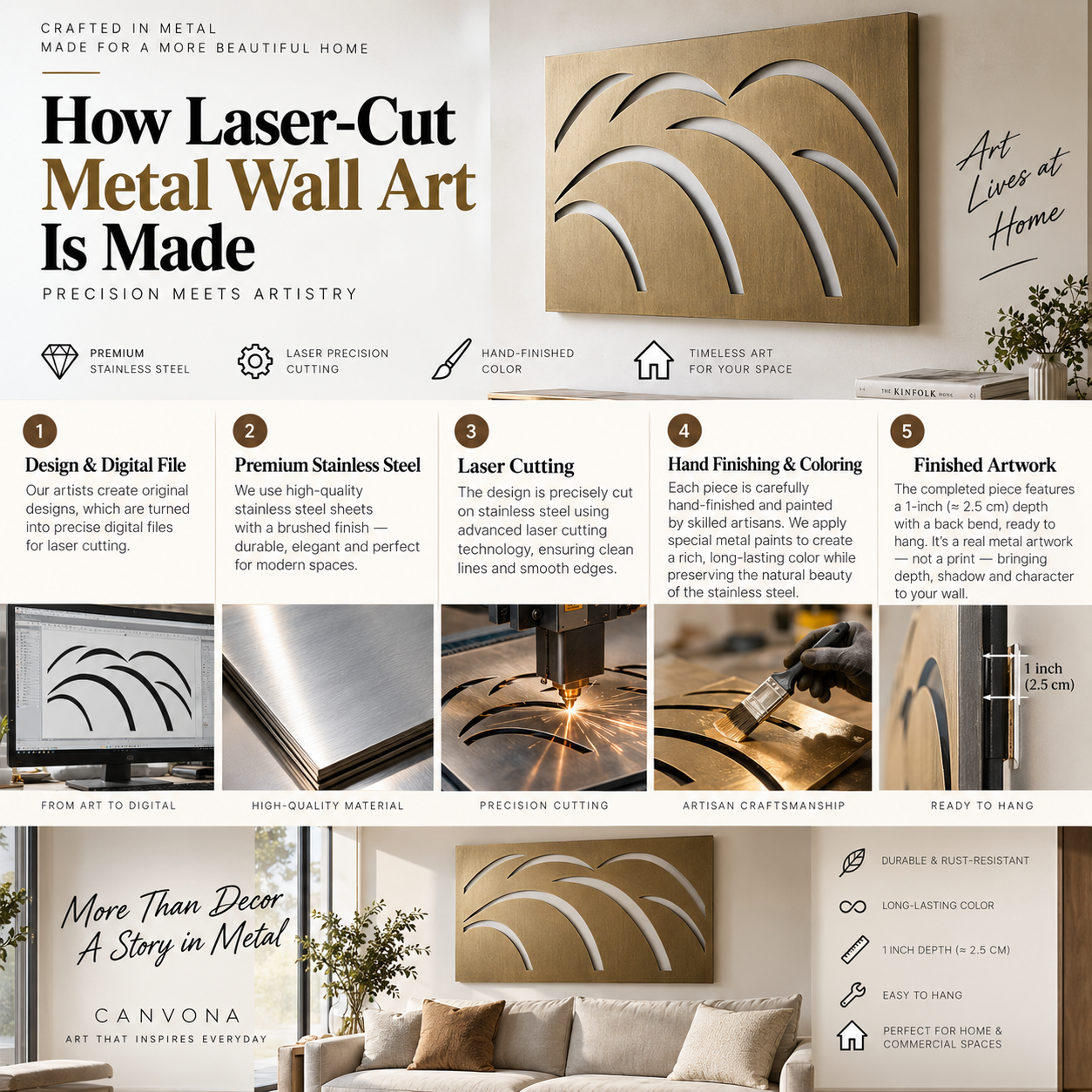
Laser-cut metal wall art begins as a design, but it must ultimately function as a physical structure.
That makes the process part art and part engineering, and it involves multiple processs and creations.
Step 1: Creating the Design
A design may begin with:
a sketch,
a photograph,
a digital composition,
an animal silhouette,
a landscape,
an abstract concept,
or a designer collaboration.
But a beautiful image is not automatically a manufacturable metal artwork.
Step 2: Converting the Design Into Cut Geometry
Areas that appear white or empty in a concept may become physical openings.
Areas that remain become metal.
This requires careful thinking about positive and negative space.
Step 3: Maintaining Structural Connections
Every important part of the artwork needs appropriate physical support.
A small decorative detail cannot simply float in the middle of a cut opening.
Elements must connect to the structure or be redesigned.
This is one of the biggest differences between drawing an image and engineering laser-cut art.
Step 4: Simplifying Details
Extremely small shapes may be beautiful on a screen but impractical in metal.
Good metal artwork often depends on simplification.
Strong silhouettes.
Clean openings.
Clear visual rhythm.
Enough material to maintain strength.
Step 5: Cutting
Once the production design is approved, a laser follows the programmed geometry and removes the required sections.
Precision matters.
Smooth shapes and clean transitions depend on accurate cutting.
Step 6: Edge Inspection
After cutting, the physical edges require inspection.
The goal is a clean, intentional finish without distracting irregularities.
Step 7: Surface Finishing
The remaining metal can receive different finishes depending on the design.
Examples may include:
black,
silver,
bronze,
brass-inspired tones,
antique finishes,
or other carefully controlled colors.
Surface treatment dramatically affects the personality of the artwork.
Step 8: Quality Control
Inspection may include:
dimensions,
cut accuracy,
edge condition,
surface finish,
structural integrity,
color,
and overall appearance.
For repeated production, finish consistency becomes especially important.
Step 9: Packaging
Metal artwork can have delicate areas despite the strength of the raw material.
Packaging must protect edges, surfaces and structural details during transportation.
Why Metal Art Looks Different in Every Room
Open areas reveal the actual wall.
That means the customer's wall color becomes part of the artwork.
Lighting creates additional depth.
The finished installation therefore changes with the environment in a way printed art cannot.
Art Meets Engineering
The strongest laser-cut pieces are not simply pictures transferred into metal.
They are designed specifically for the material.