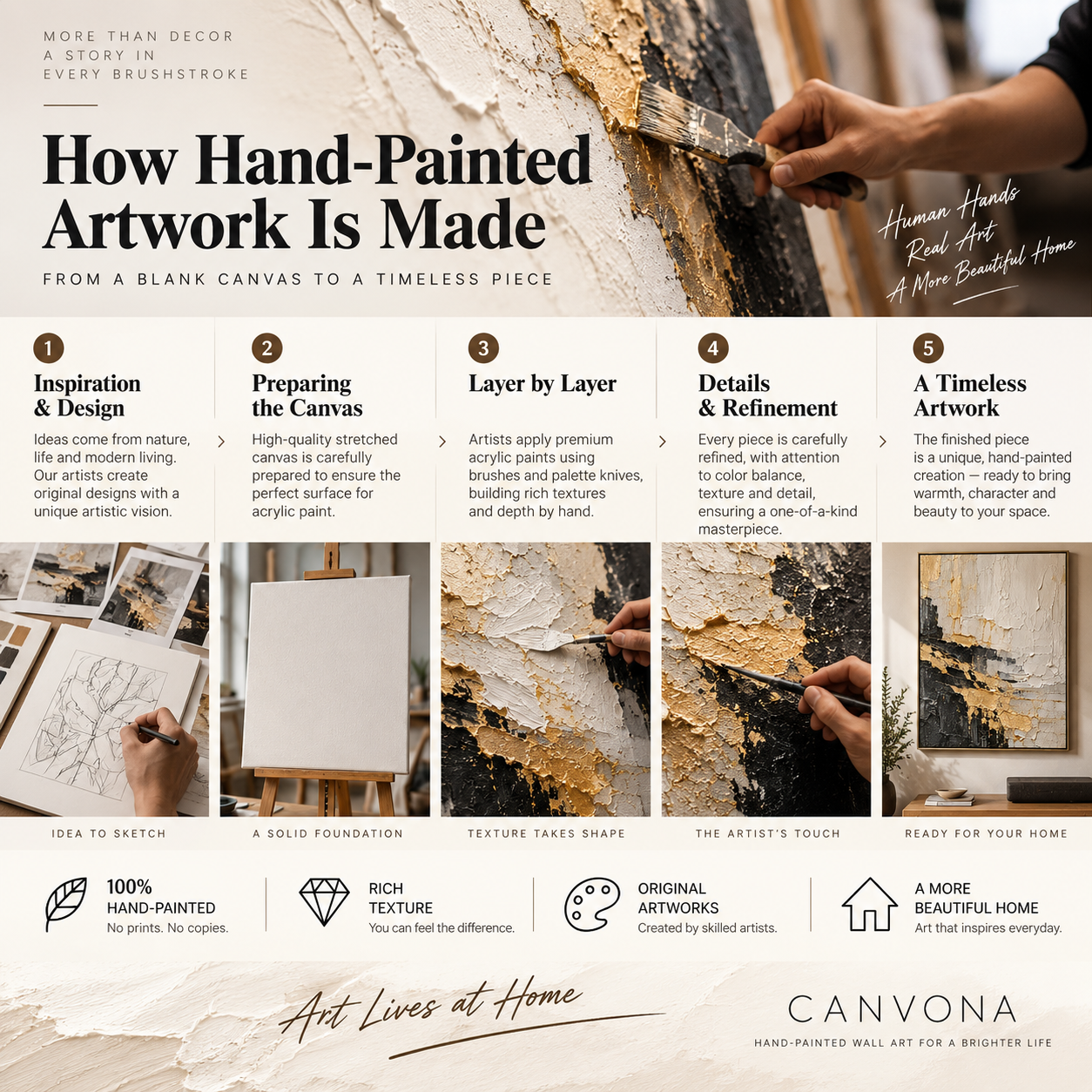
How Hand-Painted Artwork Is Made
A finished painting may look simple on the wall.
Behind it is a sequence of decisions involving design, canvas preparation, color, brushwork, texture, drying, finishing, framing and quality inspection.
Step 1: The Concept
Every artwork begins with an idea.
That may come from:
an artist's original concept,
a designer collaboration,
an interior trend,
a natural landscape,
an architectural form,
or a customer's personal photograph.
At this stage, composition and color direction are developed.
Step 2: Creation Planning
A design must work not only visually but physically.
How will the composition change at different sizes?
Which details are essential?
How thick should the texture be?
Which colors must remain consistent?
Good production planning protects the original design as it becomes a physical object.
Step 3: Preparing the Canvas
The canvas needs to be properly tensioned and prepared before painting.
A stable surface helps prevent unwanted distortion and supports consistent paint application.
Step 4: Building the Composition
The artist establishes the major shapes and color relationships.
This often begins broadly rather than with tiny details.
Strong artwork usually depends on proportion before detail.
Step 5: Applying Texture
Brushes and palette knives can create different physical effects.
Some paintings need subtle directional brushwork.
Others use raised, sculptural surfaces.
Texture should support the composition—not exist simply to make the product look handmade.
Step 6: Color Control
Handcrafted does not mean uncontrolled.
When a design belongs to a collection, colors must still follow a defined visual direction.
Good color management is especially important for ecommerce because customers form expectations from online photography.
Step 7: Drying and Finishing
Paint needs appropriate drying time before the artwork is handled, framed or packed.
Premature handling can damage the surface.
Step 8: Inspection
Quality control may include reviewing:
composition,
color,
surface condition,
dimensions,
canvas tension,
frame alignment,
corners,
cleanliness,
and packaging readiness.
This is where disciplined production management becomes especially important.
Step 9: Framing
Depending on the product, the artwork may remain gallery-wrapped or receive a floating or traditional frame.
The frame should support the artwork, not compete with it.
Step 10: Packaging
Large artwork faces another challenge: transportation.
Corners, painted surfaces and frames require protection.
Good packaging is part of the finished product experience.
Craftsmanship and Systems Can Coexist
There is sometimes an assumption that handmade means unpredictable.
It does not have to.
Human variation can remain part of the artwork while production systems protect quality.
That combination—craftsmanship plus disciplined manufacturing—is central to how we think about art at CANVONA.
See our hand-painted acrylic collection and discover how each physical artwork is brought to life.