
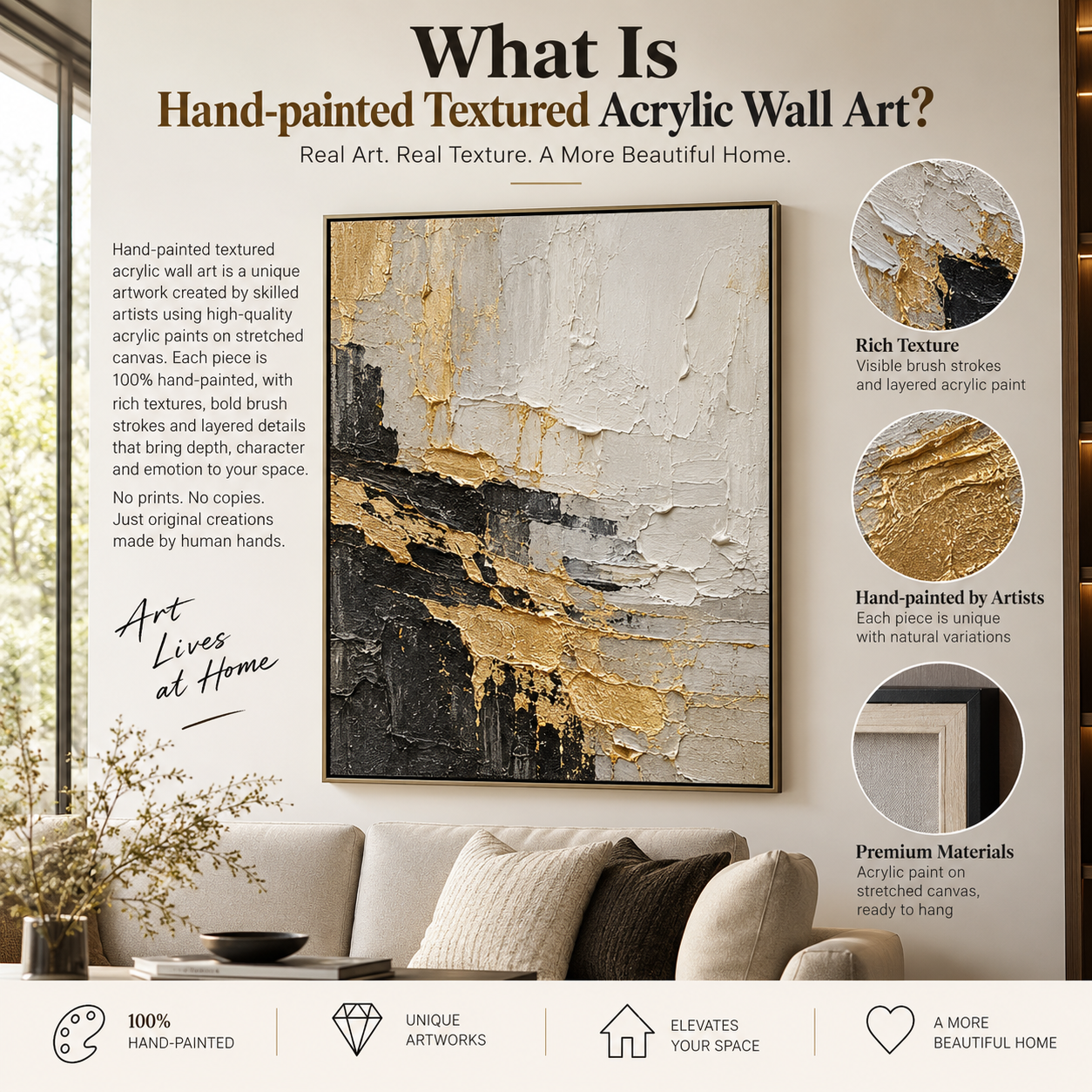
What Is Textured Acrylic Wall Art?
Textured acrylic wall art is artwork in which acrylic paint—or related painting media—is applied in a way that creates real physical depth on the surface.
Instead of simply showing the illusion of texture, the surface itself has dimension.
How Is Texture Created?
Artists can use:
brushes,
palette knives,
layering,
thicker paint applications,
and compatible texture-building materials.
The exact process depends on the design.
Why Texture Matters
Texture interacts with light.
As daylight moves through a room, raised areas create changing highlights and shadows.
This means a textured painting can appear slightly different in the morning, afternoon and evening.
Texture Is Especially Powerful in Abstract Art
Abstract artwork does not rely entirely on recognizable subjects.
Material becomes part of the visual language.
A simple beige and white composition can become dramatically more interesting when the surface contains ridges, peaks and directional movement.
Is Textured Art Always Thick?
No.
Texture ranges from subtle brushwork to highly dimensional surfaces.
Some interiors benefit from restrained, fine texture.
Others can support heavy impasto or sculptural surfaces.
Where Does It Work Best?
Textured acrylic art works particularly well in:
- living rooms;
- bedrooms;
- dining rooms;
- entryways;
- offices;
- hotel interiors.
Directional lighting can make the effect more visible.
Why Photographs Can Be Misleading
A straight-on product image can flatten texture.
That is why online shoppers should look for:
close-ups,
side angles,
lighting variation,
and video.
These reveal the surface much more accurately.
Textured Painting vs Printed Texture
A digital print can photographically reproduce the appearance of texture.
But the surface remains relatively flat.
A truly textured artwork contains physical variation you can see and feel.
Some printed products add texture afterward, so check the production description carefully.
Maintenance
Textured paintings should generally be dusted gently rather than aggressively wiped.
Raised areas can be more vulnerable than flat printed surfaces.
Why It Fits Contemporary Interiors
Many modern rooms use relatively simple furniture and color palettes.
Texture introduces depth without requiring visual clutter.
That makes textured art especially effective in minimalist and neutral spaces.
Final Thought
Texture makes a painting more than an image.
It makes it an object.